This $54 Blender Is Really Built Around Making Soy Milk
Most blenders treat soy milk as an afterthought. Xiaomi’s newest kitchen appliance builds an entire feature set around it. The Mijia Blender 3 has just launched in China at 389 yuan, roughly $54, and goes up for sale on JD.com starting September 8 at 10am local time.
According to a report by XimiTime, citing ITHome, the standout function is a segmented cooking mode that follows what Xiaomi calls an optimized soy milk cooking curve, timing the heating and blending stages to pull more nutrients out of the beans. Xiaomi claims that process lets the milk form a bean skin during preparation, boosting solid content by 10 percent and protein content by 4 percent compared to just blending and heating without the staged approach.
Quieter Than Before, and Finer Results
Noise has clearly been a focus for this generation. A 13-layer noise reduction system brings operating sound down to 45 dB(A) while blending and 51 dB(A) during juice prep, an 8 percent reduction from the previous Mijia blender. For a countertop appliance that often runs early in the morning, that’s a meaningful, if modest, improvement.
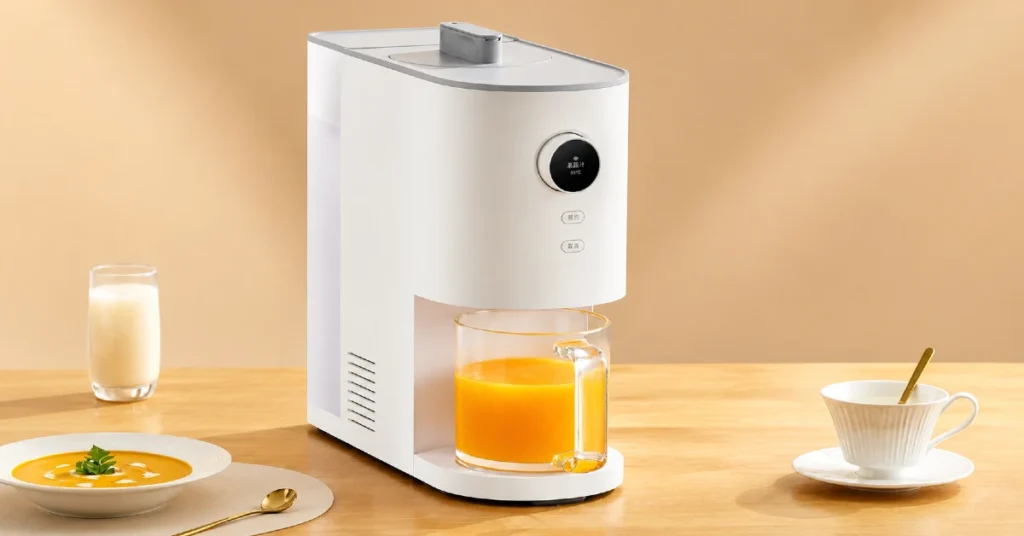
The motor itself spins at 35,000 RPM, paired with dual-layer eight-blade stainless steel knives and a 4-rib stirring pattern designed to keep ingredients moving evenly through the jar. Xiaomi says the combination gets soy milk particle size down to 100 micrometers, 21 percent finer than the outgoing model managed.
Speed and Sterilization Extras
For anyone in a hurry, an 18-minute fast mode uses water above 90°C to shortcut the usual soy milk prep time. There’s also a smart appointment boiling feature that Xiaomi says reaches a 99.99 percent sterilization rate during the bean-soaking stage, plus scheduling up to 12 hours in advance and 12-hour heat retention at 55°C once a batch is ready.
Beyond soy milk, the blender covers eight separate modes for hot and cold drinks, with dual-temperature control, a manual thickness setting, and an LED screen tracking progress in real time.
Built to Be Taken Apart and Cleaned Fast
The blade assembly uses a gravity self-locking mechanism that detaches without tools, letting the whole thing go straight under the tap without leftover residue trapped around the blades. An IPX9 waterproof rating backs that up, and the heating plate itself uses a ceramic oil non-stick coating to keep buildup from sticking during cooking. Three separate cleaning options round things out: a quick manual rinse, a high-temperature wash, and hot-air sterilization, the last of which also claims that same 99.99 percent sterilization figure.
Capacity sits at 1.5 liters, enough for roughly four servings, with a 1000mL cap for hot drinks and 1500mL for cold ones. Five separate safety features are built in too: a quiet anti-theft lid lock, lid-open protection, motor overheat protection, cup-handling protection, and dry-burn prevention.
What the Price Actually Looks Like
With China’s ongoing digital appliance subsidy applied, the effective price can drop to around 330 yuan, roughly $46. That puts a fairly feature-dense kitchen appliance, complete with scheduling, multiple safety cutoffs, and a dedicated cooking algorithm, well under $50.
It’s a reminder that Xiaomi’s home appliance strategy rarely leans on one headline spec. Instead, it stacks a handful of smaller, practical improvements (quieter operation, easier cleaning, a purpose-built cooking mode) into a device priced to compete on value rather than prestige. Whether the blender ever makes it beyond China isn’t something Xiaomi has addressed yet, but going by how past Mijia kitchen gadgets have traveled, an international release wouldn’t be a huge surprise down the line.
Source: XimiTime (via ITHome)
Also Read:
HyperOS 4: Super Xiao AI 8.2 Adds Live Animations and Task Pinning to Super Island
Xiaomi Quietly Cuts HyperOS 4 for These Android 16 Devices, Third Wave Set for September 17
HyperOS 4 Beta Brings Redesigned Camera App, But Not to the Xiaomi 17 Ultra Leica Edition
Xiaomi 18 Fold Confirmed for September Launch With Record-Breaking Xring O3 Chip