
Xiaomi has officially unveiled the Pad 9 Pro Max in China, and the feature getting the most attention isn’t the screen size or the chip, it’s a port. The tablet supports DP-IN video input over USB-C, letting it double as an external touch monitor for a computer, a stylus display for drawing, or a screen for a gaming console or handheld PC.
According to a report by MobiDevices, that’s on top of the tablet being the first device to run Xiaomi’s new in-house XRING O3 processor, alongside a 13.3-inch display running up to 144Hz and a genuinely large 12,000mAh battery.
A Screen Built for Both Video and Stylus Work
The IPS panel runs a 3408 x 2272 resolution at a 3:2 aspect ratio, hitting up to 1000 nits of peak brightness with a claimed color accuracy of ΔE≈0.47. It supports 12-bit color, DCI-P3 coverage, HDR10, HDR Vivid and Dolby Vision, plus DC Dimming down to just 1 nit and TÜV Rheinland certification for reduced blue light and flicker.
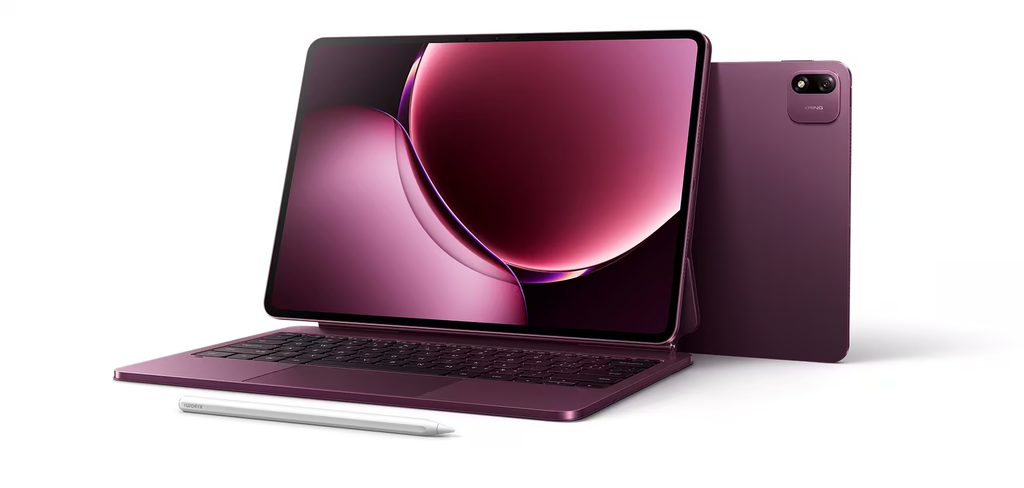
Xiaomi is also offering a nano-textured matte version alongside the standard glossy screen, aimed specifically at people using a stylus, since the matte coating cuts glare and gives the surface more of a paper-like feel under the pen tip. The metal chassis measures 296.2 x 203.08 x 5.67mm, weighing 645 grams in the standard finish or 653 grams with the matte screen, and comes in burgundy, black and silver.
The Chip Doing the Heavy Lifting
The XRING O3 is built on a 3nm process with roughly 24 billion transistors, arranged in a ten-core layout: two “C1-Ultra” cores up to 4.35GHz, four “C1-Premium” cores up to 3.68GHz, and four “C1-Pro” cores up to 3.15GHz. Memory bandwidth tops out at 113.8GB/s.
Graphics run through a 16-core G2-Ultra NX GPU with third-generation hardware ray tracing, and Xiaomi says the chip’s NPU can hit up to 200 TOPS for on-device AI tasks. Early Geekbench 6.7.1 runs put the tablet at 3,474 points single-core and 13,229 multi-core, with later results pushing multi-core past 14,000.
Xiaomi also showed off an open-world game running at 3.2K resolution and around 120 frames per second during the reveal, though it’s worth noting that number leans on super-resolution and frame generation rather than native rendering at that resolution and frame rate.
Keeping the chip cool is a thin evaporative chamber with a capillary structure, which Xiaomi says improves cooling efficiency by 11% and cuts peak processor temperature by 11°C compared to previous cooling methods.
Storage Gets More Complicated Than Usual
Memory configuration isn’t just about capacity here, it also changes memory type depending on the tier. The base 8GB+256GB model uses LPDDR5X, most 12GB and 16GB variants step up to LPDDR5T, and the top-tier 16GB+1TB configuration is the only one running Xiaomi’s newer LPDDR6 memory. All versions use UFS 4.1 storage, though there’s no microSD slot and no cellular variant announced.
Cameras, Audio and Battery
Camera hardware is kept simple for a device positioned around productivity rather than photography: a single 50MP rear sensor shooting 4K video at 60fps, and a 32MP front camera for calls and selfies at 1080p/30fps. Audio comes from an eight-speaker setup (four woofers, four tweeters) with Dolby Atmos and Hi-Res Audio support, backed by six microphones.
The 12,000mAh dual-cell battery supports 120W wired charging, reaching roughly 60% in 20 minutes according to Xiaomi. The tablet can also reverse-charge other devices at up to 27W over USB-C, and in a car, it can draw up to 45W through POGO contacts.
Built to Work Inside Xiaomi’s Cars, Too
That POGO charging detail connects to a genuinely unusual feature: the Pad 9 Pro Max can mount to the back of a front seat in a compatible Xiaomi vehicle, acting as a rear-seat display that isn’t just for entertainment. It integrates directly with the car’s systems, letting rear passengers control select vehicle functions from the tablet itself.
Software and What Ships in the Box
The tablet runs HyperOS 4, supporting up to six apps on screen at once, two- and three-window multitasking, a redesigned file manager, and a rebuilt document viewer. Xiaomi is also bundling WPS for Pad, a browser with vertical tabs and extensions, and an updated Notes app that can turn voice recordings into structured diagrams automatically.
Connectivity includes Wi-Fi 7, Bluetooth 6.0, an infrared transmitter, and a side-mounted fingerprint scanner built into the power button, along with a magnetic keyboard attachment point and a charging dock for the stylus.
Pricing in China
Sales began September 7, with pricing running from 4,799 yuan (about $715) for the base 8GB+256GB model up to 7,899 yuan (about $1,177) for the top 16GB+1TB LPDDR6 matte-screen variant. The keyboard accessory costs 1,099 yuan (roughly $164), and the Focus Pen Pro stylus runs 599 yuan (about $89). Early buyers in China get a free stylus and a DP-IN-capable USB-C cable as a launch bonus. No international release date has been announced yet.
Between the DP-IN monitor functionality, the laptop-chip-class benchmarks, and the car integration, Xiaomi clearly isn’t positioning this as a bigger phone screen with a keyboard bolted on. It’s aiming the Pad 9 Pro Max at buyers who’d otherwise be shopping for a lightweight laptop or a secondary monitor, which is a considerably bigger claim than most Android tablets have made before.
Also Read:
Xiaomi 18 Fold, Pad 9 Pro Max and Three New EVs Set for September 7 Launch: More Detail Inside
Mijia Blender 3 Launches at $54 With Soy Milk Mode and Quieter Motor
Xiaomi’s Xuanjie O3 Launch Signals a New Level of Confidence in Its Own Chips
