
Xiaomi has officially taken the wraps off the Xiaomi 18 Fold at its autumn launch event, and the design brief here is fairly literal. Both the 5.38-inch outer screen and 7.58-inch inner display use an aspect ratio close to √2:1, the same proportion as a standard sheet of paper.
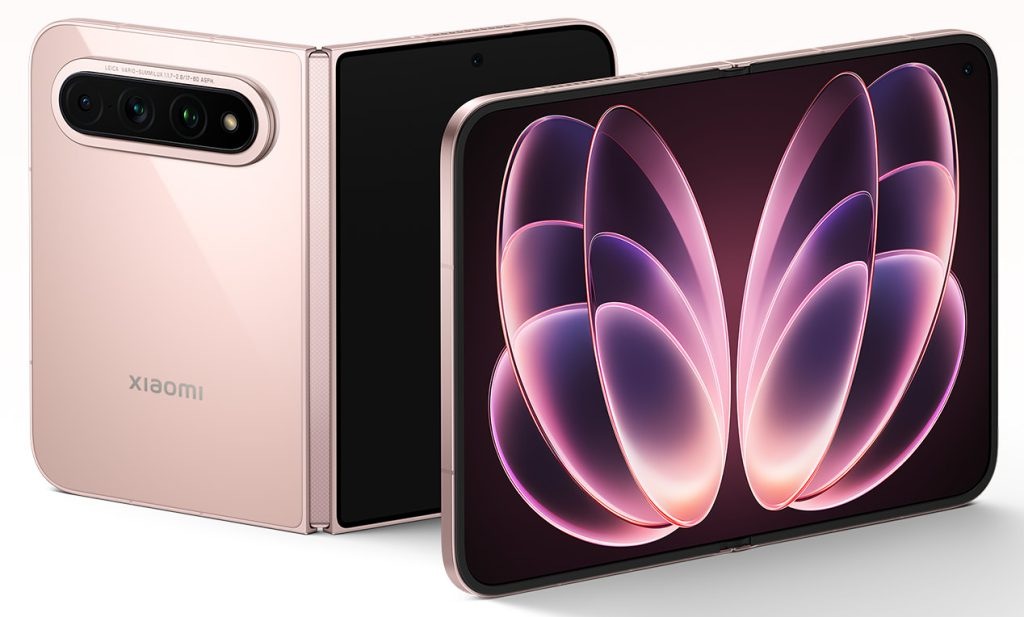
Xiaomi calls this a “mid-fold” design, and it shows up in more than just the aspect ratio. The outer screen is set up for wider horizontal typing, with Xiaomi claiming its on-screen keyboard runs 8% wider than what you’d get on a typical 6.9-inch slab phone.
Display, Build and Durability
Both panels use dynamic LTPO refresh rates from 1 to 120Hz and reach a peak brightness of 4,000 nits at 30% APL. The chassis pairs large-radius elliptical corners with a flat wraparound frame and a racetrack-shaped camera housing on the back. Unfolded, the phone measures 117.8mm by 163.8mm and just 5.02mm thick, folding down to 10.68mm and weighing 219 grams. It comes in Nishino Red, Warm Gold-White, and Black.
Xiaomi is claiming 1.2-meter drop resistance for the finished device, built around a 7-series aluminum frame and Dragon Crystal Glass 3.0. The hinge itself, Xiaomi’s next-generation Dragon Bone design, pairs a double-layer ultra-thin glass structure with organic flexible insulation, and the company says it ran 492 separate structural optimizations based on full-angle environmental and simulation testing before finalizing the build.
The XRING O3 Chip Anchors the Whole Device
This is the first phone to run Xiaomi’s flagship XRING O3 chip, which the company says benchmarks above 5 million points. Xiaomi’s own figures put CPU multi-core performance 60% higher than the previous generation, while cutting power draw by 25% under medium and low loads. The GPU side claims an 85% graphics boost alongside a 64% reduction in power consumption, and the NPU is rated at 200 TOPS of tensor computing power plus 3.13 TFLOPS of vector computing.

Memory is a first for Xiaomi too. This is the first commercial deployment of domestic LPDDR6 memory, developed jointly with Changxin Memory (CXMT). On the software side, the phone supports up to six apps running in split screen simultaneously, tied into a new voice assistant feature called the Super Xiao Ai Inspiration Ball for handling workflows hands-free.
A Full Leica Camera System
Imaging duties are co-engineered with Leica across all three rear lenses. The main sensor is a 200MP unit with an f/1.7 aperture and OIS, joined by a 50MP ultra-wide lens and a 50MP periscope telephoto offering 3.5x optical zoom through a Leica Summilux lens, also stabilized. Video tops out at 8K recording. Selfies and video calls are handled by matching 16MP cameras on both the inner and outer displays.
Battery, Charging and Ceramic Edition
Power comes from a 6,000mAh dual-layer battery, using what Xiaomi calls its Jinshajiang formula: 20% silicon content and an energy density of 920 Wh/L. Charging runs at 67W wired or 50W wireless.
Alongside the standard lineup, Xiaomi is also releasing a limited Ceramic Edition, built from silicon nitride ceramic for reduced weight and higher surface hardness. It’s locked to a single 16GB RAM plus 1TB storage configuration, with production capped at just 1,500 units globally.
Pricing and Availability
Pre-orders are open now in China, with sales beginning at 10:00 AM on September 10. Pricing runs as follows:
- 12GB + 256GB: 10,999 yuan (about $1,638)
- 12GB + 512GB: 11,999 yuan (about $1,787)
- 16GB + 512GB: 12,999 yuan (about $1,936)
- 16GB LPDDR6 + 1TB: 14,999 yuan (about $2,234)
- 16GB LPDDR6 + 1TB Ceramic Limited Edition: 15,999 yuan (about $2,383)
That pricing puts the standard Xiaomi 18 Fold well into premium foldable territory even before factoring in the ceramic variant, and it’s the clearest sign yet of how much confidence Xiaomi is placing in its own XRING O3 silicon, launching it first inside the most expensive phone the company has ever released rather than easing it in through a cheaper device.
Source: FoneArena
Also Read:
Xiaomi 18 Fold, Pad 9 Pro Max and Three New EVs Set for September 7 Launch: More Detail Inside
Mijia Blender 3 Launches at $54 With Soy Milk Mode and Quieter Motor
Xiaomi’s Xuanjie O3 Launch Signals a New Level of Confidence in Its Own Chips
