
HyperOS 4 Isn’t Just a Fresh Coat of Paint — Here’s What’s Actually New
Xiaomi’s HyperOS 4 rollout has already made headlines for which devices get it and when. Less discussed is what the update actually does once it lands on your phone — and according to a report from Cashify, it’s a genuinely substantial release rather than a visual refresh with a new version number. Built on Android 17, HyperOS 4 touches design, AI, raw performance, and how Xiaomi’s devices talk to each other.
A New Look — But Not for Everyone
The most visible change is a design language Xiaomi calls Soft Light Glass, which layers translucent panels, dynamic glass-like effects, and blur across the lock screen, home screen, icons, widgets, folders, and Control Centre. It’s a shift toward the kind of frosted, depth-heavy aesthetic that’s become common across mobile UI design over the past couple of years.
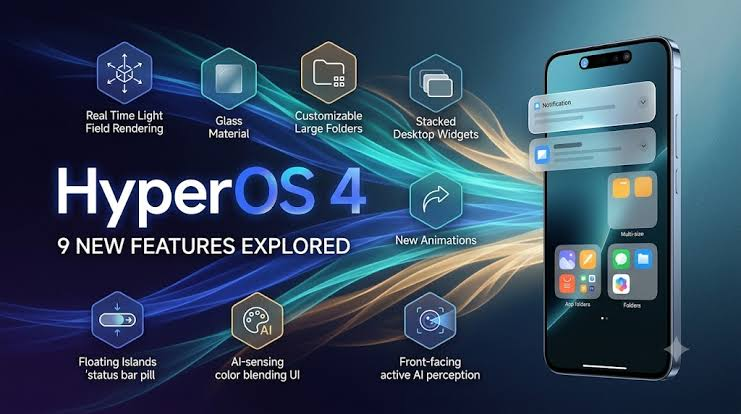
There’s a catch, though. The full visual treatment is reserved for phones running newer chipsets — Snapdragon 8 Elite or newer, MediaTek Dimensity 9500 or newer, or Xiaomi’s own Xring O1 or newer. Anyone on older hardware will still get HyperOS 4, but likely without the full glass-effect treatment, since rendering translucency and blur effects at scale takes real graphics horsepower.
Xiaomi’s AI Assistant Gets a Serious Upgrade
The AI side of this update centers on Super XiaoAi 2.0, running on Xiaomi’s own MiMo V2.5 large language model. Unlike a typical voice assistant that just answers questions, this version is built to read what’s on your screen, retain context across a session, and carry out tasks that span multiple apps rather than staying siloed in one.
Two features stand out: Expert Mode, which can execute multi-step instructions rather than one command at a time, and Inspiration Ball, which proactively suggests actions based on whatever’s currently on screen. Xiaomi has also folded AI into its Recorder and Voice Notes apps, letting them auto-generate summaries, pull out key points, and turn spoken notes into task lists.
The Performance Numbers Xiaomi Is Touting
Xiaomi is leaning hard on specific performance claims with this release. The company says an AI-driven memory preloading system delivers 27.2% more available memory and 17% faster app launches once a phone has been running for a while — the kind of gain that matters most on a device that’s been in daily use for months rather than fresh out of the box.
A new HyperCore engine is also part of the pitch, which Xiaomi claims cuts redundant CPU instructions by about 14.4% compared to HyperOS 3. The practical result, according to the company, includes smoother scrolling in the Gallery app, quicker camera launches, and faster HDR photo processing. As with any manufacturer-reported benchmark, these figures reflect Xiaomi’s own internal testing rather than independent verification, so real-world results may vary by device and use case.
Lock Screen Gets Genuinely More Customizable
The lock screen redesign goes beyond swapping wallpapers. Users can now resize, reposition, and stretch the clock display itself, while notifications shift to a vertically stacked layout instead of the older format. Xiaomi has also added spatial depth effects, letting a subject in a photo appear to sit in front of the clock or other lock screen elements — a small touch, but one that makes the lock screen feel less static.
Two Xiaomi Phones Can Now Share One Phone Number
Perhaps the most functionally useful addition here is Dual Phone Syncing. It lets two Xiaomi, Redmi, or POCO devices share incoming calls and SMS verification codes over the internet — even if the two phones are on entirely different mobile networks — as long as both are signed into the same Xiaomi account.
That’s a genuinely practical feature for anyone juggling a work phone and a personal phone, or a primary device and a backup. Missing an SMS OTP because it landed on the “wrong” phone is a common enough annoyance that this could matter more in daily use than flashier AI features. For now, though, it’s limited to China, with no confirmed timeline for wider availability.
The Bigger Picture
Taken together, these five changes suggest Xiaomi treated HyperOS 4 as more than routine maintenance. A new design language, a considerably more capable AI assistant, measurable performance claims, and a cross-device feature that solves a real annoyance — that’s a broader scope than most yearly Android skin updates attempt. Whether the performance numbers hold up outside Xiaomi’s own testing, and how quickly features like Dual Phone Syncing reach markets beyond China, are the open questions worth watching as the update reaches more devices.
Source: Xiaomi
- Xiaomi’s New Washer-Dryer Costs Nearly Double Its Predecessor — Here’s What You Get for the Extra Money
- Xiaomi 18 Standard Model Clears Certification — December Launch Now Looking Likely
- Xiaomi Confirms Global Xiaomi 18 Pro Launch Date: Before November Ends
- Global Xiaomi 18 Pro Buyers Are Getting a Smaller Battery — Here’s Why
- Xiaomi Publishes Its Full HyperOS 4 Rollout Calendar — Here’s the Complete Device List
