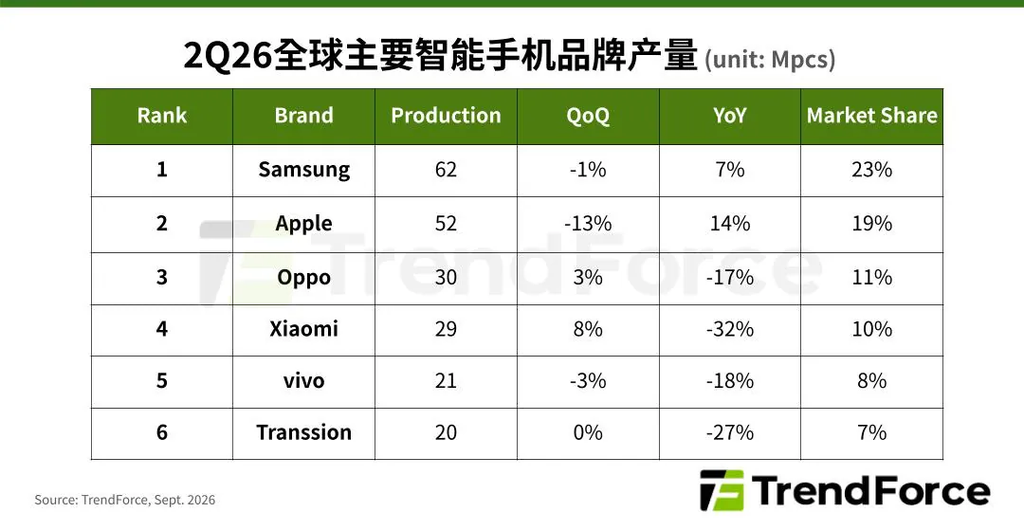
Global smartphone production dropped in the second quarter of 2026, but not by as much as analysts initially feared. Market research firm TrendForce reports that manufacturers produced around 275 million units in Q2, an 8% decline year over year.
According to a report by XimiTime, citing ithome.com and TrendForce’s own data, that decline is real, but it landed considerably softer than what the firm had originally projected for the quarter.
Samsung and Apple Both Grew While Everyone Else Held Steady
The top of the rankings tells an interesting story on its own. Samsung kept its number one position with roughly 62 million units produced, actually growing 7% year over year. TrendForce credits that growth to earlier flagship releases this cycle combined with heavier use of ODM (Original Design Manufacturer) production on its mid-range and budget models, a strategy that helped the company manage rising memory chip costs without pushing retail prices up.
Apple came in second with about 52 million units, up a stronger 14% year over year. That growth traces back to how the iPhone 17 series was priced. Whether that momentum carries into the iPhone 18 series is less certain, since TrendForce expects prices to rise for that generation, leaving its eventual sales performance an open question.
Xiaomi Holds Its Ground Rather Than Chasing Growth
Xiaomi landed in fourth place with roughly 29 million units produced, working out to close to 10% of total global output for the quarter. That places it between OPPO’s 30 million units in third and vivo’s 21 million in fifth.
What stands out is less the ranking itself and more the strategy behind it. TrendForce describes OPPO, Xiaomi, and vivo as all prioritizing stable market share and steady profitability over aggressive volume growth this quarter, a notably different posture from Samsung and Apple, both of which posted real year-over-year gains. In a quarter where the overall market shrank, simply holding position without losing ground is arguably its own kind of result, even if it doesn’t make for as flashy a headline as double-digit growth.
TrendForce Raised Its Full-Year Outlook
The stronger-than-expected Q2 performance was enough to move TrendForce’s full-year forecast. The firm raised its 2026 global production estimate by 20 million units, from 1.05 billion to 1.07 billion, trimming the projected annual decline from 16% down to 14%.
TrendForce points to two factors behind the upward revision: earlier-than-expected consumer purchases and manufacturers restocking their production plans more aggressively than initially planned.
What This Actually Means
None of this changes the fact that the smartphone market is still shrinking on a global basis this year. What it does suggest is that the decline is moderating a bit faster than analysts expected a few months ago, with growth concentrated at the very top of the market rather than spread evenly across every major manufacturer. For Xiaomi specifically, holding a roughly 10% share of global output while OPPO and vivo do the same suggests the mid-tier of the smartphone market is settling into a more defensive posture for now, focused on protecting existing position rather than fighting for a bigger slice while overall demand keeps contracting.
Source: XimiTime (via ithome.com, TrendForce)
Also Read:
Xiaomi 18 Fold, Pad 9 Pro Max and Three New EVs Set for September 7 Launch: More Detail Inside
Mijia Blender 3 Launches at $54 With Soy Milk Mode and Quieter Motor
Xiaomi’s Xuanjie O3 Launch Signals a New Level of Confidence in Its Own Chips