If you’ve been importing Xiaomi’s Pro-series phones out of necessity rather than choice, you can finally stop. Xiaomi confirmed on X that both the Xiaomi 18 Pro and Xiaomi 18 Pro Max are heading to international markets, Europe included, according to a report from TECHBOOK. That sentence might not sound like huge news on its own, but the context around it is what makes this worth paying attention to.
Here’s why: Xiaomi hasn’t sold a global Pro model since the Xiaomi 13 Pro in 2023. Every “Pro” flagship since then — the 14 Pro, the 15 Pro, the 17 Pro stayed locked inside China.
If you wanted one anywhere else, your only real option was buying an imported unit and living with whatever compromises came with it: software quirks tuned for Chinese carriers and app stores, no official warranty coverage, and the ever-present risk that updates would slow to a crawl or stop altogether once Xiaomi decided your region wasn’t worth supporting. It’s the kind of workaround enthusiasts tolerate because they want the hardware badly enough, not because it’s actually a good experience.
Also Read: Xiaomi 18 Leak Reveals 6.4-Inch Display, Snapdragon 8 Elite Gen 6, 200MP Triple Camera
That three-year gap is why this announcement reads less like routine product news and more like Xiaomi quietly admitting the import workaround had become a long-term headache worth fixing.
What You’re Actually Getting
Specs-wise, nothing here is a surprise if you’ve been following the China launch Xiaomi isn’t holding back a watered-down version for the rest of the world, at least not on paper. The standard Xiaomi 18 Pro runs Qualcomm’s new Snapdragon 8 Elite Gen 6, pairs it with up to 16GB of RAM, and puts a 6.4-inch LTPO AMOLED panel on front capable of hitting 4,000 nits at peak brightness.
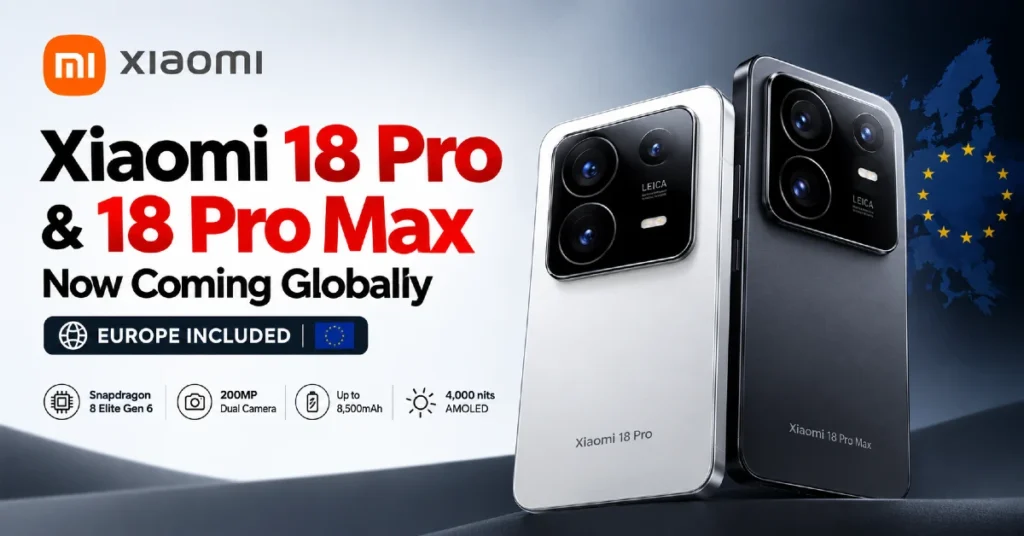
That’s a genuinely bright screen, well past what most flagships manage, and it should make a real difference using the phone outdoors in direct sun. Round things out with a triple camera built around two 200-megapixel sensors, and a 7,000mAh battery that’s enormous by almost any phone’s standards.
Step up to the Pro Max and the chip gets swapped for the beefier Snapdragon 8 Elite Extreme, the screen grows to 6.9 inches, and the battery balloons further still, to a claimed 8,500mAh. On paper, that’s one of the largest batteries you’ll find in a mainstream flagship phone anywhere right now.
So far, so good. But there’s a catch buried in the rumor mill that’s worth sitting with before you get too excited about those battery numbers.
The Catch Nobody’s Officially Confirmed Yet
Code pulled from HyperOS firmware — the kind of leak that tends to be more reliable than a random tipster’s guess, since it’s coming from the software Xiaomi itself is building points to global versions of both phones shipping with noticeably smaller batteries than their Chinese siblings. The numbers floating around suggest 6,000mAh for the international 18 Pro and 7,050mAh for the Pro Max, down from 7,000 and 8,500 respectively back home.
I’ll be honest: this isn’t shocking, and if you’ve followed Xiaomi’s last couple of flagship cycles, you’ve seen this movie before. The Xiaomi 17 did the same thing, dropping from 7,000mAh in China to 6,330mAh internationally. The 17 Ultra took a similar hit.
The most commonly cited explanation is that European rules around lithium-ion battery transport cap how much energy a single cell is allowed to carry, and getting around that limit usually means splitting the battery into two smaller cells, which adds bulk and thickness that most companies would rather avoid on a phone they’re trying to sell as sleek and premium.
Also Read: Xiaomi HyperOS 4: New Design, Smarter AI Assistant, and Dual Phone Syncing Explained
None of this is confirmed by Xiaomi directly yet, so treat it as a strong likelihood rather than settled fact. But given the pattern, I wouldn’t bet against it.
Pricing Is Still a Mystery
In China, pricing starts at 5,999 yuan for the base Xiaomi 18 Pro configuration and 6,999 yuan for the entry-level Pro Max — working out to roughly $895 and $1,045 at current exchange rates, though actual European retail pricing almost never maps directly onto a currency conversion. VAT, import costs, and regional margin all tend to push the real number higher once a phone actually lands on shelves outside China.
For now, Xiaomi hasn’t said what either phone will cost in Europe, or given a firm release date beyond “later this year.” If I had to guess, I’d expect more concrete details within the next few weeks — Xiaomi doesn’t typically let a confirmed global launch sit without specifics for too long, especially once a phone has already generated this much attention from international outlets and buyers.
Why This Actually Matters
Step back from the spec sheet for a second and the bigger story here is about market strategy, not hardware. Xiaomi pulling its Pro line out of international markets for three straight years was a strange choice for a company that’s spent the better part of a decade trying to compete seriously with Samsung and Apple outside China. Reversing that decision now suggests Xiaomi either underestimated how much demand there was for the Pro tier specifically, or decided the “good enough” non-Pro flagships it was selling internationally weren’t cutting it against the competition.
Either way, if you’ve been eyeing a Xiaomi flagship and holding off because the Pro model wasn’t officially available where you live, this is the news you’ve been waiting for. Just don’t expect the battery life to quite match what Chinese buyers are getting — and don’t expect Xiaomi to confirm a price until it’s good and ready to.
Source: XiaomiUI.
Also Read: New Leak Fills In the Xiaomi 18’s Missing Specs — Bigger Battery Than the Pro, Same Chip