Xiaomi has officially launched the Redmi K100 in China, combining a 10,000mAh battery, Snapdragon 8 Elite processor and 165Hz OLED display. The phone starts at 2,999 yuan (approximately $430) during the limited-time Double 11 promotion, making it an interesting option for buyers who prioritize battery life and gaming performance.
What caught my attention isn’t the processor itself. Xiaomi has chosen a previous-generation flagship chip but surrounded it with hardware designed for extended gaming sessions, including a dedicated graphics processor, advanced cooling and fast charging.
It’s a different approach from simply introducing a newer Snapdragon processor every year. And depending on how the K100 performs outside Xiaomi’s laboratory, that decision could make sense.
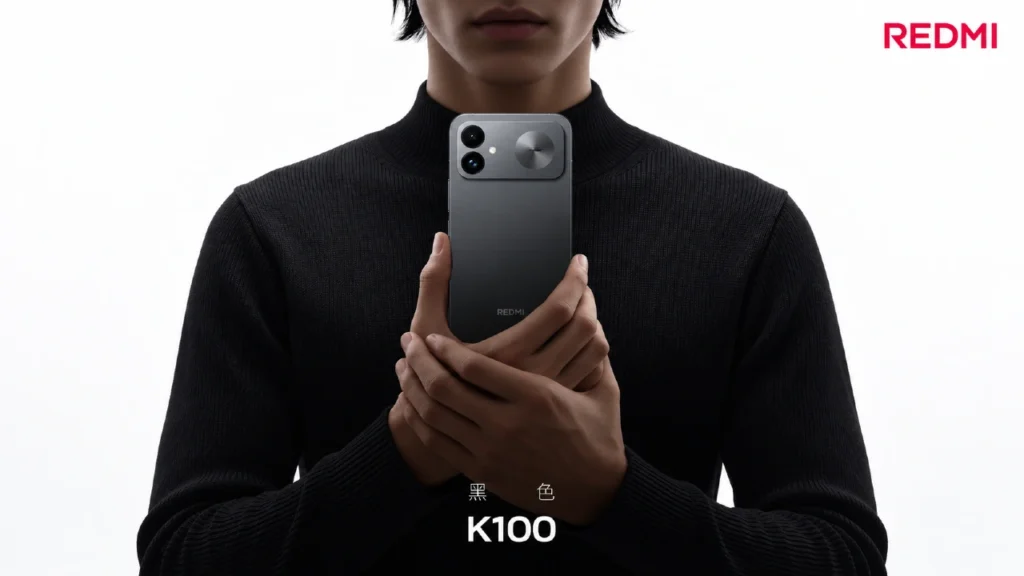
Redmi K100 Price in China and Availability
The Redmi K100 was announced on October 27, 2026, with pre-orders opening immediately. Official sales begin on October 31 at 10 AM China time.
Xiaomi is offering three RAM and storage configurations. Each receives a limited-time discount during China’s Double 11 shopping promotion.
| Configuration | Regular price | Promotional price |
|---|---|---|
| 12GB + 256GB | ¥3,499 | ¥2,999 |
| 12GB + 512GB | ¥4,099 | ¥3,499 |
| 16GB + 512GB | ¥4,499 | ¥3,899 |
Eligible customers in China can receive additional government subsidies, reducing the effective prices to approximately ¥2,549.15, ¥2,999 and ¥3,399, respectively.
These subsidized amounts are conditional offers, not the standard retail prices.
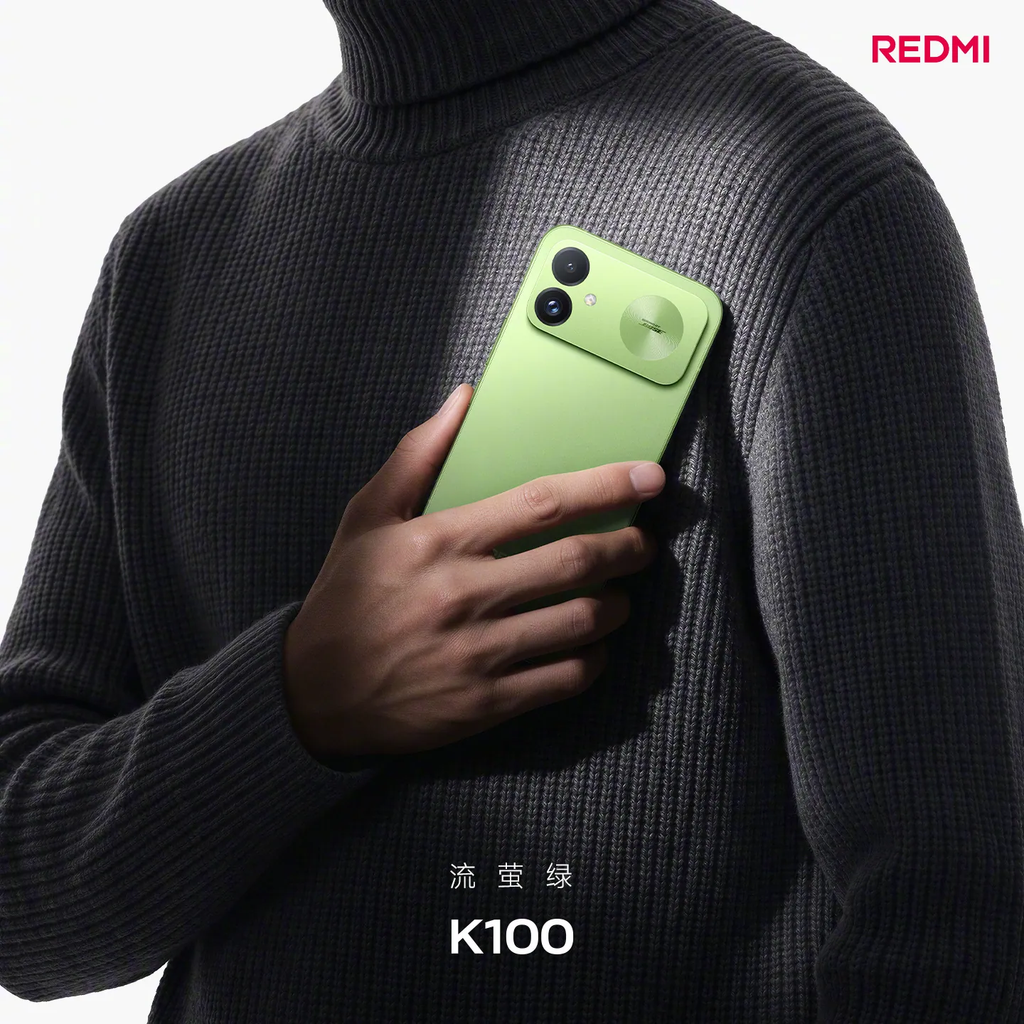
The handset comes in Black, Snow Rock White and Firefly Green. Xiaomi has also used a rounded metal frame measuring 1.3mm along its edges and a flat camera housing intended to make horizontal gaming more comfortable.
For now, the Redmi K100 remains a China-exclusive release. Xiaomi hasn’t announced an international launch, Indian pricing or plans to introduce the device under POCO branding.
Snapdragon 8 Elite Powers the Redmi K100
The Redmi K100 uses Qualcomm’s Snapdragon 8 Elite, a 3nm flagship processor with an Oryon CPU architecture featuring two prime cores and six performance cores.
Although the chipset isn’t Qualcomm’s newest flagship platform in 2026, it remains powerful hardware for demanding applications and gaming.
Xiaomi pairs it with LPDDR5X Ultra RAM and UFS 4.1 storage, with configurations reaching 16GB RAM and 512GB storage.
More interestingly, the standard K100 gets Xiaomi’s dedicated D2 gaming graphics chip for the first time. The additional hardware supports frame interpolation and super-resolution processing to improve the gaming experience in compatible titles.
Xiaomi claims more than 40 games support native 165fps gameplay, while over 100 titles can benefit from supported super-resolution and frame-enhancement features.
Those numbers sound impressive, but they don’t mean every game will run at 165fps. Actual performance depends on software compatibility, graphics settings and thermal conditions.
Advanced Cooling for Longer Gaming Sessions
To manage heat, Xiaomi has included a 3D circulating cold-pump cooling system alongside more than 12,000mm² of high-conductivity graphite material.
This is particularly relevant because the Snapdragon 8 Elite can generate substantial heat during sustained workloads.
Effective cooling could help the phone maintain more consistent frame rates instead of reducing performance after several minutes of demanding gameplay.
Independent testing will be necessary to determine how well the cooling system performs over longer sessions.
165Hz OLED Display and a Massive 10,000mAh Battery
The Redmi K100 features a 6.83-inch flat OLED display with a 2772 × 1280 resolution, commonly marketed as 1.5K.
Its refresh rate reaches 165Hz, accompanied by a 480Hz touch reporting rate and up to 3,500Hz instantaneous touch sampling.
The panel supports HDR10+, Dolby Vision, 12-bit colors and DCI-P3 color coverage. Xiaomi also advertises 3,500 nits of peak brightness.
For visual comfort, the company includes full-brightness DC dimming, circularly polarized light technology and its Qingshan Eye Protection 4.0 system.
These features could make the display suitable for both gaming and everyday media consumption, although peak brightness shouldn’t be confused with sustained full-screen brightness.
Battery Life and Charging Specifications
The biggest upgrade is the 10,000mAh silicon-carbon battery, which Xiaomi describes as its largest smartphone battery to date.
According to company testing, the Redmi K100 can deliver approximately 2.43 days of usage under Xiaomi’s laboratory conditions.
That’s an encouraging claim, especially considering the phone’s high-refresh-rate display and powerful chipset. However, actual endurance will vary depending on network conditions, gaming habits and screen brightness.
Charging features include 100W wired fast charging, 27W wired reverse charging and bypass charging.
Bypass charging is particularly useful for gaming because it can supply power more directly to the device while reducing unnecessary battery charging and associated heat.
The large battery does affect the phone’s dimensions. The Redmi K100 measures 162.91 × 77.93 × 8.65mm and weighs 234.5 grams.
In other words, this isn’t a particularly lightweight smartphone.
Redmi K100 Cameras, HyperOS 4 and Other Features
While gaming and battery endurance dominate the specification sheet, Xiaomi hasn’t ignored the cameras entirely.
The Redmi K100 includes a 50MP primary camera using the Light Hunter 800 sensor, an f/1.68 aperture and optical image stabilization. An 8MP ultrawide camera completes the rear setup, while a 20MP front camera handles selfies and video calls.
Also Read: Xiaomi Smart Band 11 Launches in Europe With NFC & More: Complete Details inside