Xiaomi’s Redmi division has revealed a major challenge facing smartphone manufacturers. According to Redmi product manager Hu Xinxin, memory costs have climbed approximately 5.5 times over the past 12 months, forcing companies to reconsider how they balance hardware specifications and pricing.
The timing is particularly interesting. Xiaomi recently introduced the Redmi K100 in China with a 10,000mAh battery and Snapdragon 8 Elite processor, but its official pricing highlights the growing difficulty of keeping performance-focused smartphones affordable.
The rising costs could have wider consequences, with industry reports suggesting that some familiar smartphone and tablet product lines may eventually disappear.
Redmi Reveals How Expensive Smartphone Memory Has Become
Hu Xinxin recently discussed the increasing cost of memory components, explaining that smartphone manufacturers now face tougher decisions when selecting hardware for new devices. According to publicly available third-party industry data referenced by the Redmi executive, memory associated with a 12GB RAM and 256GB storage configuration now costs nearly 2,000 yuan (approximately $275).
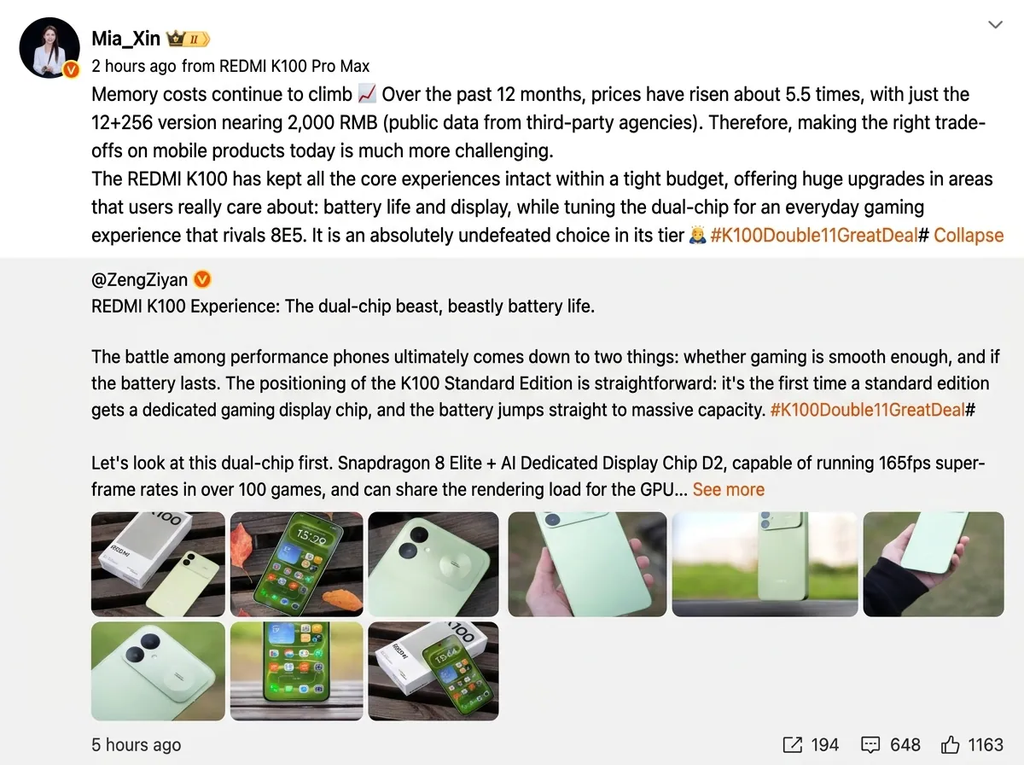
That is a substantial expense when compared with the retail prices of many mid-range smartphones. The reported 5.5-fold increase covers the past year, although Redmi hasn’t provided a detailed breakdown of individual RAM and storage component prices or confirmed that every manufacturer faces identical costs.
Rising memory expenses can affect more than the final retail price. Manufacturers may need to choose between offering additional storage, newer processors, improved cameras or larger batteries while keeping devices within a particular price range. For a brand such as Redmi, which has traditionally emphasized competitive hardware pricing, those decisions are becoming increasingly difficult.
Redmi K100 Pricing Shows the Pressure on Affordable Flagships
The recently launched Redmi K100 provides a useful example of how Xiaomi is responding to the situation. The smartphone starts at 3,499 yuan (approximately $480) in China, although a limited-time Double 11 promotional offer reduces the entry price to 2,999 yuan (approximately $411).
Eligible buyers can receive additional government subsidies, bringing the effective starting price down to approximately 2,549 yuan. Here is the complete Chinese pricing structure:
| Configuration | Regular price | Double 11 price | Subsidized price |
|---|---|---|---|
| 12GB + 256GB | ¥3,499 | ¥2,999 | ¥2,549.15 |
| 12GB + 512GB | ¥4,099 | ¥3,499 | ¥2,999 |
| 16GB + 512GB | ¥4,499 | ¥3,899 | ¥3,399 |
The promotional and subsidized prices should not be confused with Xiaomi’s recommended retail prices. Government subsidies also depend on customer eligibility and local conditions. The Redmi K100 remains a China-focused smartphone, with no global launch currently planned.
Why Xiaomi Retained the Snapdragon 8 Elite
One particularly interesting decision is Xiaomi’s choice to retain the Snapdragon 8 Elite processor previously used in the Redmi K90. Instead of introducing a newer flagship chipset, Xiaomi focused on features such as a larger 10,000mAh battery, a 165Hz display and the dedicated D2 gaming graphics chip. The K100 also lacks a dedicated telephoto camera.
Chinese technology publication PChome has suggested that these decisions reflect the growing pressure of component costs, although Xiaomi hasn’t publicly attributed every hardware choice to rising memory prices.
I think this is where the situation becomes relevant for everyday buyers. A smartphone can still deliver meaningful improvements without receiving a newer processor, but customers may begin noticing fewer upgrades in other areas.
Rising Component Costs Could Reshape Smartphone Lineups
The pressure isn’t limited to Redmi. According to Chinese tipster Digital Chat Station, several familiar smartphone and tablet product lines could reportedly be discontinued because increasing manufacturing costs are making new releases financially difficult to justify. No specific upcoming Redmi cancellation has been officially confirmed. However, other manufacturers have already announced significant changes to their product strategies.
On February 27, Meizu revealed that it was suspending the independent development of new smartphone hardware for the Chinese market while exploring partnerships with third-party manufacturers. The company said its existing operations would remain unaffected. OPPO also announced changes to its sub-brand strategy on July 16. Under that plan, realme would concentrate on overseas markets while suspending new product updates in China.
OnePlus, meanwhile, would focus primarily on China while maintaining product updates in India and pausing new smartphone releases in Europe and North America. These decisions demonstrate how manufacturers are adjusting their market priorities, although rising memory prices have not been established as the sole reason behind every company’s restructuring.
What Rising Memory Prices Mean for Xiaomi Buyers
The biggest concern is whether consumers will eventually pay more for smartphones that offer fewer annual hardware upgrades. Manufacturers have several possible responses: increase retail prices, reduce certain specifications, extend product refresh cycles or concentrate on models with stronger profit margins.
None of those outcomes is guaranteed for Redmi, but its latest comments show that component costs are already influencing product planning. Personally, I think Xiaomi’s decision to prioritize battery life and display performance on the Redmi K100 is understandable. Those improvements could matter more to many buyers than a newer processor.
Still, if memory costs remain elevated, keeping future Redmi and POCO devices competitively priced could become increasingly challenging. For now, Redmi’s reported 5.5-fold memory cost increase offers a clearer explanation of the financial pressure facing smartphone manufacturers, even as the industry continues developing more powerful devices.
Also Read:
Redmi Pad 3 Clears China Certification, Charging Details Emerge Ahead of Launch
Xiaomi Smart Band 11 May launch in India around ₹3,999, Report Suggest
Xiaomi Unveils Shoe Washer With 8 Cleaning Modes for Just $116