Xiaomi’s upcoming Redmi Pad 3 has reportedly moved another step closer to launch, with a new tablet passing China’s 3C certification. The listing reveals charging adapter details, while earlier leaks suggest a larger battery, multiple memory configurations and optional 4G connectivity.
The interesting part is the apparent mismatch between the tablet’s rumored charging capability and the adapter supplied in the box. Although the Redmi Pad 3 is expected to support 18W charging, its certification points to a 15W bundled charger.
For a budget tablet that could carry a battery approaching 10,000mAh, charging speed may become an important consideration for buyers.

Redmi Pad 3 Appears on China’s 3C Database
A new Xiaomi tablet carrying model number M887FA reportedly received China’s compulsory 3C certification on October 28, 2026.
According to information shared by Weibo tipster Experience More, the device is believed to be the upcoming Redmi Pad 3, although the certification itself does not establish that retail name.
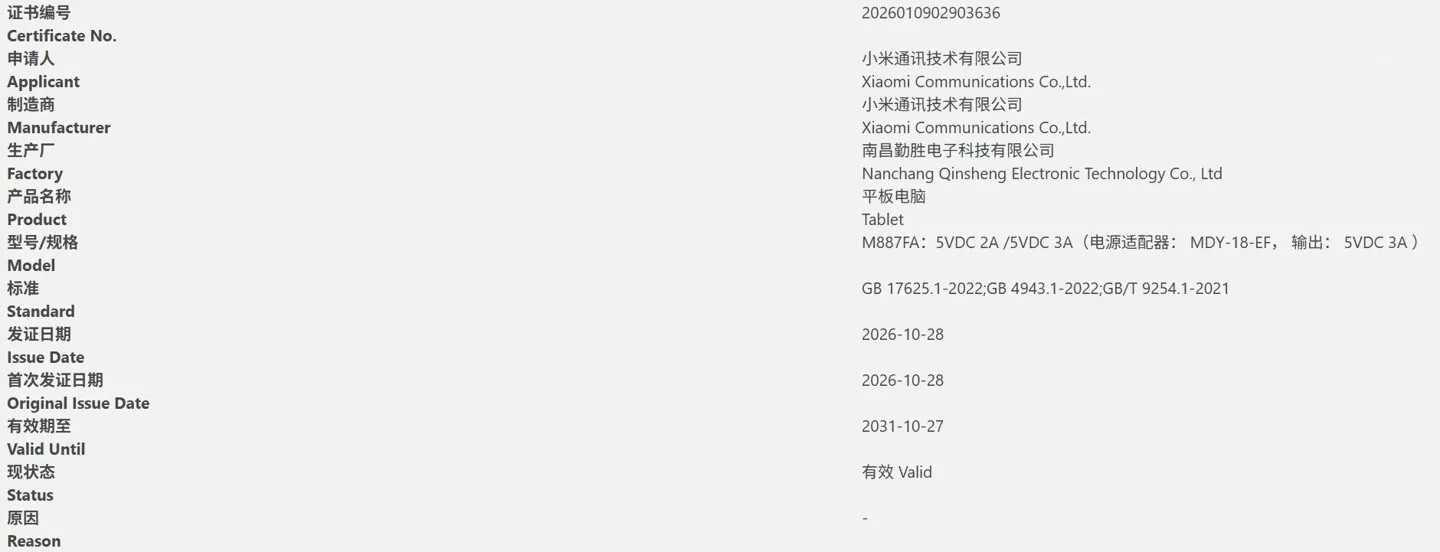
The filing lists an MDY-18-EF power adapter rated at 15W. The adapter is manufactured by Nanchang Qinsheng Electronics Technology Co., Ltd., a Jiangxi-based manufacturer involved in producing electronic devices and accessories for Xiaomi and other brands.
Earlier reports suggested that the tablet would support up to 18W charging. The latest information therefore raises the possibility that buyers may receive a slower charger than the device’s maximum supported charging speed.
However, an adapter rating isn’t necessarily the same as the maximum charging capability of the tablet itself. Xiaomi has not officially confirmed the Redmi Pad 3’s charging specifications, so the reported 18W support remains provisional.
Bigger Battery and Three Memory Options Expected
Previous certification reports have provided additional information about Xiaomi’s next affordable tablet. The Redmi Pad 3 is expected to feature a 9,820mAh rated battery, with some reports referring to a typical capacity of approximately 10,000mAh.
That would represent an increase over the Redmi Pad 2’s 9,000mAh battery, although the exact improvement in real-world endurance will depend on the processor, display and software efficiency.
The upcoming tablet is also tipped to arrive in three memory configurations:
| RAM | Storage |
|---|---|
| 4GB | 128GB |
| 6GB | 128GB |
| 8GB | 256GB |
Reports further suggest the availability of a 4G model and an IP52 dust and water resistance rating.
An IP52 rating would provide limited protection against dust ingress and dripping water under specified test conditions. It would not make the tablet waterproof. Several important specifications remain unknown, including the processor, screen dimensions, physical size and weight.
The absence of those details makes it difficult to determine whether Xiaomi is preparing a substantial hardware upgrade or a more modest refresh focused on battery capacity.
Redmi Pad 3 Global Launch Also Looks Possible
China isn’t the only market where Xiaomi’s next Redmi tablet has appeared in certification reports. Earlier this month, a device identified as the Redmi Pad 3 was spotted on the UAE’s TDRA database with model number 2610FRP38G.
The same Wi-Fi-only variant subsequently appeared on Indonesia’s SDPPI certification database, receiving approval dated October 27.
Meanwhile, another model, 26104RPF2G, has been associated with the expected 4G version through previous regulatory listings.These appearances suggest Xiaomi could be preparing both cellular and Wi-Fi configurations for international markets.
However, the Chinese model M887FA has not been conclusively linked to those global identifiers. Certification approvals also do not guarantee an immediate commercial release.
Xiaomi has yet to announce the official Redmi Pad 3 launch date, pricing or supported markets, including India.
How Much Better Could It Be Than Redmi Pad 2?
The Redmi Pad 2 provides a useful starting point for understanding what Xiaomi might improve. Launched in China in August 2025, the tablet features an 11-inch 2.5K display, MediaTek Helio G100-Ultra processor and a 9,000mAh battery with 18W charging support. It measures 7.36mm thick and weighs approximately 510 grams.
The model initially started at 999 yuan in China, giving Xiaomi a relatively affordable option for video streaming, reading, studying and everyday entertainment.
The Redmi Pad 3’s rumored battery increase would be a welcome improvement, particularly for users who spend long periods watching videos or attending online classes.
Still, I think the processor and display will matter just as much as the larger battery. A more efficient chipset could improve battery endurance and responsiveness, while a better screen could make the tablet more appealing for multimedia use.
Charging is another area worth watching. Keeping the same 18W maximum while increasing battery capacity could result in lengthy charging sessions.
For now, the Redmi Pad 3 certification offers a useful glimpse of Xiaomi’s preparations, but it doesn’t reveal enough to judge the tablet’s overall value.The next major clues will likely come from additional regulatory listings or Xiaomi’s official announcement.
Would you prefer a Redmi Pad 3 with a larger battery, or should Xiaomi focus on faster charging and a more powerful processor? Share your thoughts below.
Source: ithome.com
Also Read:
Xiaomi Smart Band 11 May launch in India around ₹3,999, Report Suggest
Xiaomi Unveils Shoe Washer With 8 Cleaning Modes for Just $116